thoughts on modern dating: how we date
I got tired hearing about dating horrors, so I muted “dating” on my feeds. Then I wrote this: dating apps and events, and a positive response to dating.

Kopi Date invited me to try their experience. I'm writing from my own experiences of heterosexual dating. The opinions and verdict are all mine.
Remember the days when people used to flirt at cafes, bars or other third spaces and asked someone they fancied out? Someone caught your eye, a friend nudged you, or someone walked up to say hello, phone numbers exchanged. I've experienced it a few times, but mostly heard about it through friends or social media. Dating might never be the easiest, but at least it was face to face.
While conventional dating persists, dating apps are now the default way to get a date. And whenever the dating discourse is brought up, it's an echo chamber of complaints about dating horrors and the bar being in hell. Think: situationships, dating burnouts (overstimulated by swipes and failed dates), and ghosting people because of conflict avoidance. Maybe they have always existed just that it's somehow more normalised and we've given them names. I've been on the receiving end too, but that's not what's draining for me. It's the rumination of how modern dating is depicted that is draining and demotivating. Yes, it sucks but endlessly rehashing it won't make it any better. On my feeds, I've aggressively muted "situationships", "attachment styles", and even general keywords such as "dating" and "relationships". It's one thing to make fun of a phenomenon and another to reinforce the same problems across the globe.
Everyone is describing the problems, but hardly anyone is trying to improve them. The biggest question I keep asking myself: why aren't we envisioning a healthier dating experience? Why aren't there more conversations around healthy dating and connections instead?
Yes I'm tired of hearing about modern dating, so naturally I'm going to spend a few paragraphs about dating apps and events first (lol) – most of which try to optimise for compatibility, with little success. I'll try to be quick, so bear with me.
Dating apps
I know people who met on dating apps and are married now. But now it doesn't feel like what it used to be during the early days, and it attracts a certain type of crowd.
Tinder for hook-ups, Coffee Meets Bagel for serious intentions of marriage, while Bumble is somewhere in between. Hinge isn't available in Malaysia, but I heard it's not much different from Bumble and I don't want to go through the hassle of getting a VPN. These days the apps unsurprisingly conflate the two intentions. The line gets blurry when "open to see how it goes" could mean a casual fling or friends first. When online dating expanded the world of dating and provided thousands of choices, dating patterns would naturally change.
The paradox of choice is real. There are thousands of options, so your brain tries to filter them and the criteria are usually more superficial. Like, why is height placed high up in the list of qualities? Men who aren't conventionally attractive (and rich) and can't get a match might swipe right on almost everyone to see what they can get out of it. Most women get pickier and less likely to settle for "less". It's good to have standards! But some standards can be over the top. It's dehumanising when everyone becomes an option in this marketplace, waiting to get picked.
Dating profiles don't quite help either. They show the idealised version of a person, leaving little room for personality and freedom to design your profile. You don't actually know someone's true behaviour until you meet in person. There's a limited time window to impress someone, so it's easy to lose interest if the other person isn't funny or charming within a few messages. In real life, you'd at least give them more attention to read their vibe (on top of their physical attractiveness), unlike online dating when attention spans are shorter.
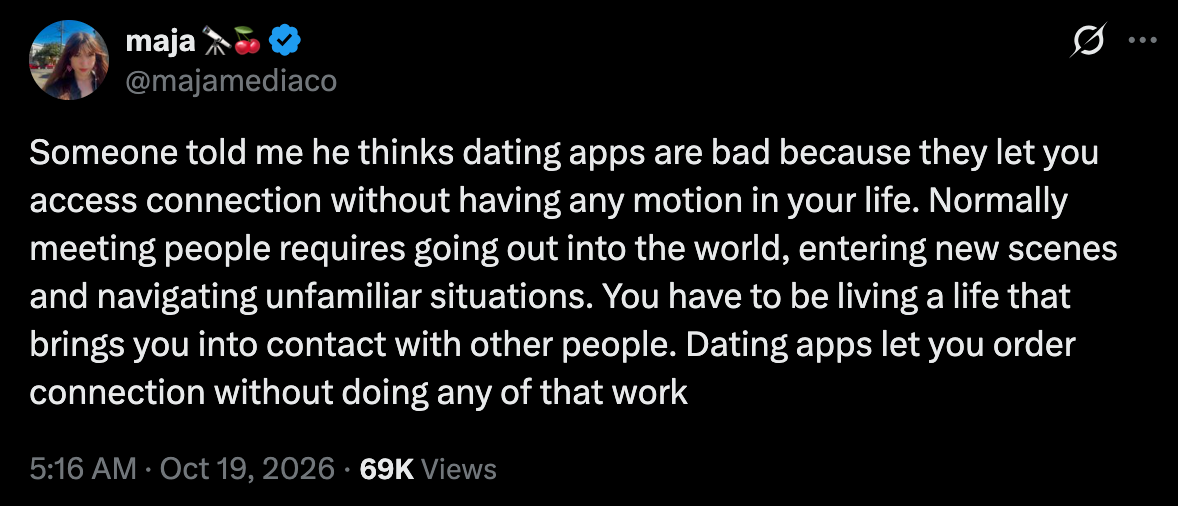
Attention is a precious resource in this age of optimised apps, but many have lost it from doomscrolling infinite feeds. Coupled with convenience in our hands, it's easy to forget that getting to know someone requires effort. Many conversations lose momentum, or rather, there's no reciprocity. You ask a question or crack a joke. They reply haha yeah. Then nothing for days – the lead runs cold. You wonder if the fault lies with you (or your looks), or them. Sometimes it's both. Many people aren't being intentional, because of the unwillingness to invest in a person when choices seem "endless". They hope to optimise for the "best" results.
Dating events
Social events are on the rise. People are drained from dating apps, so they turn to events to meet potential partners.
Most events have a shared social context, like an event for pet owners or travel. For dating, it's single people tired of dating apps looking for love offline. A shared context is important to bring people together, but the best scenario for dating events (and awkward part) is finding a match and not returning. Returning can feel embarrassing, because it can feel like announcing you're still "unwanted" even though that's not true.
I'm still reluctant because these events are pricey for what they are. I also doubt the quality of the event, because organising an event is different from hosting one. Some hosts misuse "community", thinking it's just a group of people gathered and expecting people to overcome the awkwardness to break the ice themselves. Granted there is some curation, because they make you fill up a form to gauge your vibe first.
As my friend S put it: For RM99, you could meet the love of your life! I could, but I could also use that money for a nice gourmet meal. I could also be in the comforts of my home with my non-existent cats.
However, it's only a matter of time before my curiosity overcomes my concerns.
I do put myself "out there" outside of the realm of dating events, like events centred around my hobbies or career. I believe meeting new people with no explicit reason to date brings out the best of us, because there is less pressure to perform. At an event of your interest, you get to have fun and meet new friends. While at dating events, the expectation of dating someone is implicitly formed, so people might not show up in their authentic selves – some are more guarded or give off "desperate" energy, unless a good host can naturally break that barrier of ice.
These events provide the means to meet new people, but if two people do find each other, it's left to them to follow through after. The question is if these events should be partially responsible for following through the matchmaking, or leave it to the red string of fate.
Something in between: Curated platforms
Traditional matchmaking services still exist. Even though they are more curated, I'd like dating to stay a bit carefree and fun, not like I've hired a corporate service. But if not for these services, is there anything in between?
That's when I came across Kopi Date (or rather, they found me). They sound like a response to the frustration of modern dating, offering a more curated 1-1 dating experience from almost end to end. After a personal introductory call with them (that's not part of the member's process), they suggested I experience their onboarding process as a member would, through a simulated version.
After I signed up on their app, a Kopi Date artisan walked me through the kind of person I’d enjoy and asked thoughtful questions in their onboarding call. Their questions made me reflect on the traits I desire in a person, like why growth mindset is important to me in my partner. They also gave another example: height. It matters a lot to some people, because what they might truly want is a sense of security and protection.
Many people desire a sustainable long-term relationship, myself included, but few ask why it matters to them or why they want the traits they want in a partner. Is it to escape loneliness or fill their void with someone else? Or to create lifelong memories with someone? Must they be 6ft tall with millions in their bank account right now? I love that the team helps break them down and leaves you with better questions to reflect on. Some people aren't equipped with a good support system too while dating, so that's where Kopi Date can help as a guide.
Here's how the rest works. In the app, you're connected with one person at a time and meet them over coffee. Kopi Date arranges the date on behalf; it creates a better condition for people to connect, instead of endlessly texting. Their filtering process is thorough. Before you're accepted, you fill up a form detailing who you are and what you're looking for, then chat with their team to gauge your compatibility with the platform. There's a fee, but it's much more affordable than a traditional matchmaking service and it screens people out who are more serious about dating.
Beyond curating a dating experience, Kopi Date combines personal growth in their members' dating journey. It isn't simply dating to find the one, but dating to discover and improve yourself as a person. After each date, the team reflects with members over a call. They also encourage members to reflect in their own time with many guided reflections and quizzes in the app or on Telegram app, so members carry what they learn into the next date. In the end, you're paying for intentionality, curation, arrangement of the date, and guidance throughout your dating journey.
We already outsource finding dates to dating apps. And now it's the process of dating itself, which raises the question:
When did dating become so siloed that we'd need to rely on apps and services?
There's a supposed curse in which you'd lose your date when you start talking enthusiastically about them with your family and friends, especially if you've put them on the pedestal. It's also embarrassing to have a streak of unrealised dates, so people feel discouraged and keep to themselves until a relationship is certain. Some people would go as far as to call it a humiliation ritual.
We used to have a friend or family member who'd say: you two should meet. Most of us lost that, or got too embarrassed by it. So, maybe a dating service like Kopi Date can be a stand-in for the friend who knows you well enough to introduce you. But I'd also love for us to trust our family and friends a little bit more again. There's a higher motivation to stay in a relationship too when it involves someone your friend or family knows.
I still haven't been on a Kopi Date. They're based in Singapore and Sydney for now (unless there's a similar platform in Malaysia I'm missing – let me know). I'm already an introspective person by nature, but that one call left me reflecting more about my dating patterns. I might unmute "dating", who knows. But all in all, I just want someone open to growing and experiencing life together, with wonder and curiosity.
👁️ More observations around dating that I'm thinking about, perhaps in another post:
- Did the pandemic ruin our social skills, and with them dating skills? When people relied on dating apps, it made things more convenient, including connecting with others. So people put less effort into connecting with people, especially when everything is optimised.
- Outside of dating, the brainrot from doomscrolling social media is real.
- Social media warps the younger generation's view of real experiences. They spend more time online than going out, socialising, learning about the world through their own lived experience.
- Are people more afraid of rejection now that anyone can be recorded and mocked online? Related to cringe culture.
- Can third spaces (and even fourth spaces) revive the desire to go out and socialise? There are plenty of initiatives for making new friends that way now.
- Are people more aware of their unresolved childhood problems and patterns that they're afraid of dating? Perhaps because they over-therapise themselves, constantly protect themselves, and learned what their version of love are from their parents? (aka attachment styles)
- Why are situationships normalised? Or have they always existed, just with a name now? To people who conveniently stay in situationships: are you the one with a commitment issue, or the one with a lack of self-respect and self-worth that leaves you craving for validation from other people?
- Expectations of dating itself. When everyone is under pressure to perform and being interviewed, no one is having fun. Why aren't we treating our dates like human beings? We can still treat it like a date, but treat the other person as a friend first and allow the relationship to develop more naturally.
- Families doting on their sons. Many sons grow up expecting the same from their partners too: to clean up after them, to organise things for them. What they want is a servant, not someone to grow with in a relationship.
- We're less dependent on each other. People no longer need to depend on marriage for sex. People no longer need to depend economically on each other to pay the bills. In this case, women can earn enough to support themselves now unlike in the 20th century. On that note –
- With more freedom of choice, women have grown enormously over these past few decades in their careers, hobbies, and social lives. They value the same or perhaps even more from potential male partners. Some men can deliver, but many can't provide economically enough to be attractive to these women. Many women can already afford the lifestyle they want, so all they need is someone with good character.
- Even though women can provide for themselves now, they still value men with more economic power, because somehow it still provides a sense of safety and protection.
- More women have more masculine energy, while more men have more feminine energy. A more masculine woman may seek a man who is more masculine than she is, or she might attract a more feminine man. These energies aren't related to sex or gender; they're closer or similar to concept of yin and yang.